
Before autism.
Before communication boards.
Before therapy binders and sensory charts…
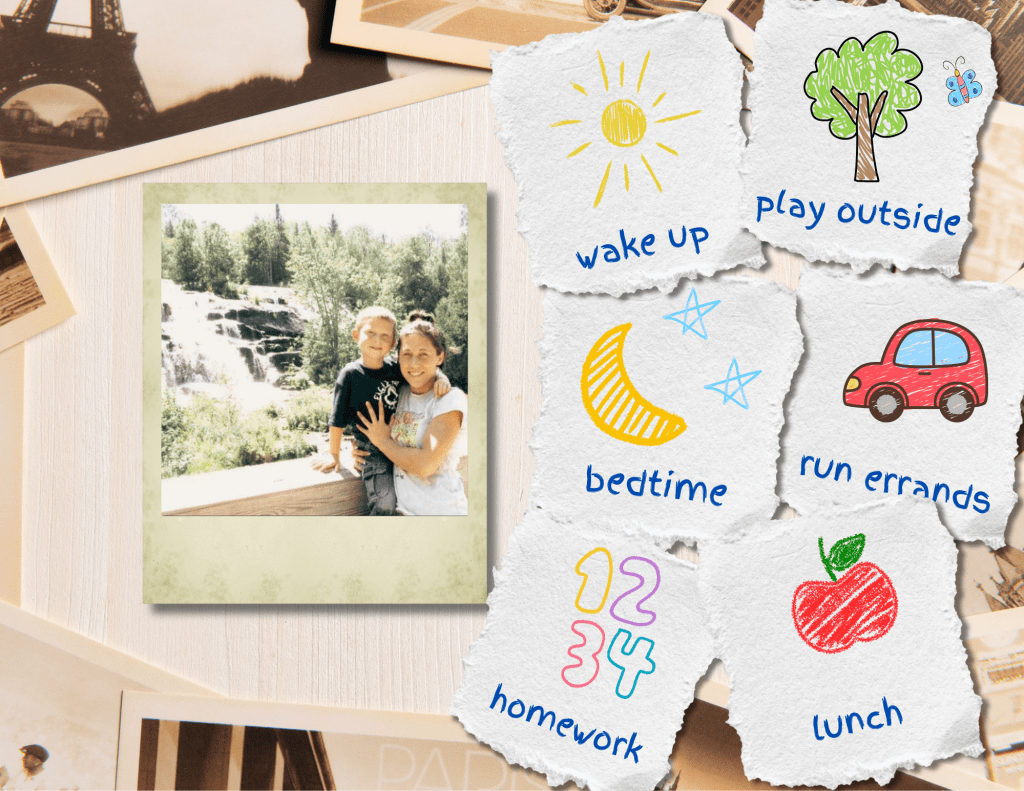
I was sitting at my kitchen table with a notebook and a pencil, drawing routines for my firstborn, Michael.
Michael has ADHD.
He’s in his twenties now, but when he was little, no one gave me visual schedules or executive function tools. There were no Pinterest boards full of printables. There was just a tired mom, a confused little boy, and a piece of paper with stick-figure drawings of what was supposed to happen next.
That was my beginning.
And I didn’t realize it at the time, but those hand-drawn schedules were my first visual supports.
What ADHD Really Does to a Child’s Brain
ADHD (Attention-Deficit/Hyperactivity Disorder) is not a behavior problem.
It is a neurodevelopmental difference that affects how the brain manages:
• attention
• working memory
• impulse control
• emotional regulation
• task switching
• organization
In an ADHD brain, the part responsible for executive function works differently. Executive function is the brain’s ability to plan, prioritize, remember steps, and start or finish tasks.
So when you say:
“Get dressed, brush your teeth, grab your backpack, and go wait by the door…”
An ADHD child does not hear four instructions.
They hear noise.
Their brain drops steps, forgets the middle, or freezes entirely.
That’s why Michael needed to be told one thing at a time, at eye level, with clear, simple directions.
And without his schedule, he truly did not know what to do next.
Not because he didn’t care.
But because his brain couldn’t organize the information.
Why Visual Supports Work So Well for ADHD
Visual supports bypass the overloaded thinking part of the brain and go straight to what the ADHD brain does best: seeing.
A visual schedule turns:
“What am I supposed to do?”
into
“I can see what’s next.”
Instead of holding steps in their head (which is very hard for ADHD), the child can simply look.
Visual supports provide:
• predictability
• reduced anxiety
• fewer power struggles
• better follow-through
• emotional regulation
When Michael had his little paper schedule, his shoulders would relax. He wasn’t guessing anymore. He wasn’t waiting for correction. He knew what came next.
That changed everything.
ADHD, Emotions, and Overwhelm
ADHD also affects emotional regulation. When children don’t know what’s expected, or they feel behind, their nervous system goes into fight, flight, or freeze.
That’s when you see:
• meltdowns
• defiance
• shutting down
• anxiety
Visual supports make the day feel safer.
They take the invisible and make it visible.
And when children feel safe, they can learn.
How This Led Me to Create What I Sell Today
Years later, when Ava was diagnosed with autism, I realized something powerful:
What helped my ADHD son also helped my autistic daughter.
Visual schedules.
Clear routines.
Predictable structure.
One thing at a time.
The tools I once hand-drew on notebook paper are now what I design for families everywhere.
Because these supports don’t just help children — they help parents breathe.
Tools That Help ADHD Families Thrive
If you’re raising a child with ADHD, these tools can make your days calmer and more manageable:
🧩 Visual Schedules
Perfect for:
• morning routines
• homework
• bedtime
• transitions
They replace constant reminders with visual clarity.
👉 Daily Routine Wall Pocket Visual Schedule – Etsy
👉 Large Visual Wall Calendar – Etsy
👉 All-in-one Visual Schedule System, AM/PM Routine, Chores, First/then Chart – Etsy
🗓 Weekly Planner
When you’re juggling:
• therapy
• school
• work
• multiple children
Having a visual plan for the week reduces stress and mental overload.
👉 Amazon.com: Weekly Planner: Dorethy, Teika: Books
✅ Today (To-Do) List
ADHD brains (kids AND parents) do better when tasks are broken into small, visible steps.
This tool helps everyone know what needs to be done — without yelling, nagging, or forgetting.
👉 Amazon.com: Today Planner: Dorethy, Teika: Books
You Are Not Behind
If you’re reading this and feeling exhausted, overwhelmed, or unsure…
I see you.
I was there, with a pencil, a notebook, and a little boy who just needed the world to slow down.
Visual supports didn’t fix everything — but they gave us a way forward.
And sometimes, that’s everything.
 Ava Has Autism
Leave a comment